
Why solar is a bright business opportunity
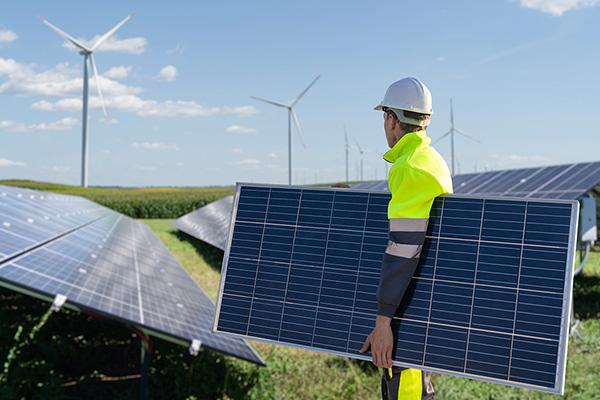

More businesses than ever are looking to cash in on a free resource – the sun. By granting a lease of ground or air space to a solar panel provider, business property owners can take advantage of cheap solar energy without incurring the upfront capital cost of acquiring and installing solar panels.
So how do these schemes work? What are some of the pitfalls to consider? What are the main legal documents to have in place?
Robin Adams, partner in our commercial team, explores the opportunities and potential risks and offers some top tips to consider before embarking on a solar scheme for your business.
What is the opportunity?
Business property owners grant a lease to the solar panel provider who in turn installs the panels on the site owner’s land or building and then sells the energy generated back to the site owner.
How does the arrangement work?
- The provider generally supplies, arranges and funds the installation of the solar panels.
- They recoup that investment, with a return, by selling the generated energy to the site owner at a rate which is generally lower than those available for energy from non-renewable sources supplied through the National Grid.
- Any excess energy generated by the panels can be sold to a third-party supplier. The revenue from that might be split between the site owner and the provider or retained entirely by the site owner or the provider.
A site owner will also benefit from energy cost savings over the period of the arrangement without having to incur any upfront capital cost for the solar panels.
Who owns the solar panels?
Ownership of the solar panels remains with the provider, although the site owner may have the right to buy them from the provider when the arrangement comes to an end.
The provider will also need to maintain the panels and keep them in good working order for the duration of the arrangement.
How long does the arrangement last?
A 15, 20 or 25 year term is not uncommon, but this will depend on the provider’s financial model.
The parties also need to consider early termination rights where for example the other party breaches the terms of the relevant agreements or enters an insolvency process. The parties might also agree to no fault termination rights, perhaps only exercisable after a minimum initial term.
If the site owner ends the arrangement early, the provider may expect a compensation payment. However, this should not apply where the site owner terminates because the provider has failed to comply with the relevant agreements or enters some form of insolvency process.
What permissions or consents are required?
The parties will need to consider and obtain any necessary planning permission for the installation and operation of the solar panels.
The site owner will need to obtain any necessary consents from a superior landlord or any bank or other party with a mortgage or other security over the site. That needs to be done before the relevant agreements are entered into.
Alternatively, the agreements can be entered into beforehand, but the installation and supply needs to be conditional on those permissions and consents being obtained.
What if the installation is delayed?
A site owner may want the option to terminate the agreements if the installation and supply of energy has not happened or started within a specified period. A provider may also want a similar right. A party should not have that right if they are the cause of the delay.
If the whole arrangement is conditional on planning permission or some third-party consent, it is important to consider what happens if the relevant conditions have not been met by a certain date.
What price applies to the energy supplied to the site owner?
The rate charged for the energy generated by the solar panels and sold to the site owner may be agreed at the outset, as a simple rate, in pounds and pence, per kWh, most likely index linked. Alternatively, it may be determined on some other basis, say, by reference to national energy pricing information published by the government.
A provider may specify a minimum annual payment, payable regardless of whether the site owner consumes the corresponding amount of energy. An owner may want to argue that the minimum payment be reduced by the amount of any revenue received by the provider from the sale of unused energy to third parties.
Are there any other issues to consider?
Yes.
- What happens if the owner wants to sell the site?
- Will the buyer have to continue to buy the energy under the power purchase agreement?
- If the provider becomes insolvent or breaches the agreement, will the provider’s funder want to have the option of stepping in?
- Is an alternative dispute resolution mechanism required, such as mediation?
- Are third party guarantees required in relation to any party’s obligations under the relevant agreements?
- What insurance needs to be in place and what commitments will the parties give each other about this?
- What limits, caps or exclusions of liability does either party require, in relation to breaches of the relevant agreements or other claims relating to the scheme?
And finally, what documents will be required?
Most commonly, there needs to be a lease of the relevant roof or ground airspace in favour of the provider, as tenant, alongside a power purchase agreement between the provider and site owner for the supply and purchase of the energy. Ahead of that, a non-binding offer letter or heads of terms can be useful but is not essential.
The lease and power purchase agreement need to be harmonised, so that, for example, each comes to an end when the other does, and provisions dealing with, for example, the price and payment for the energy, minimum payments and the installation and maintenance of the solar panels are not duplicated.
Muckle LLP has provided legal advice regarding various solar panel schemes. If you would like to discuss your own solar panel scheme or any of the issues raised in this article, please contact Robin Adams at [email protected] or on 0191 211 7949.
- Provider supplies, arranges, funds installation of solar panels
- Provider sells generated energy to site owner
- Excess energy is sold to a third party supplier
The provider
- Planning permission may be needed.
- Equally the site owner may need permission from a superior landlord or a bank or other party with a mortgage or security over the site.